Key Takeaways
Many motorized FA lenses share the identical optical platform with their manual versions — the premium buys mechanics and electronics, not better glass.
Electric focus pays off when working distance changes, when equipment is remote or sealed, when focus must move during operation, or when camera fleets run on recipes.
For single fixed stations, a manual lens with a lock screw remains the right answer.
A simple changeover-frequency calculation tells you where the crossover point sits for your line.
Introduction
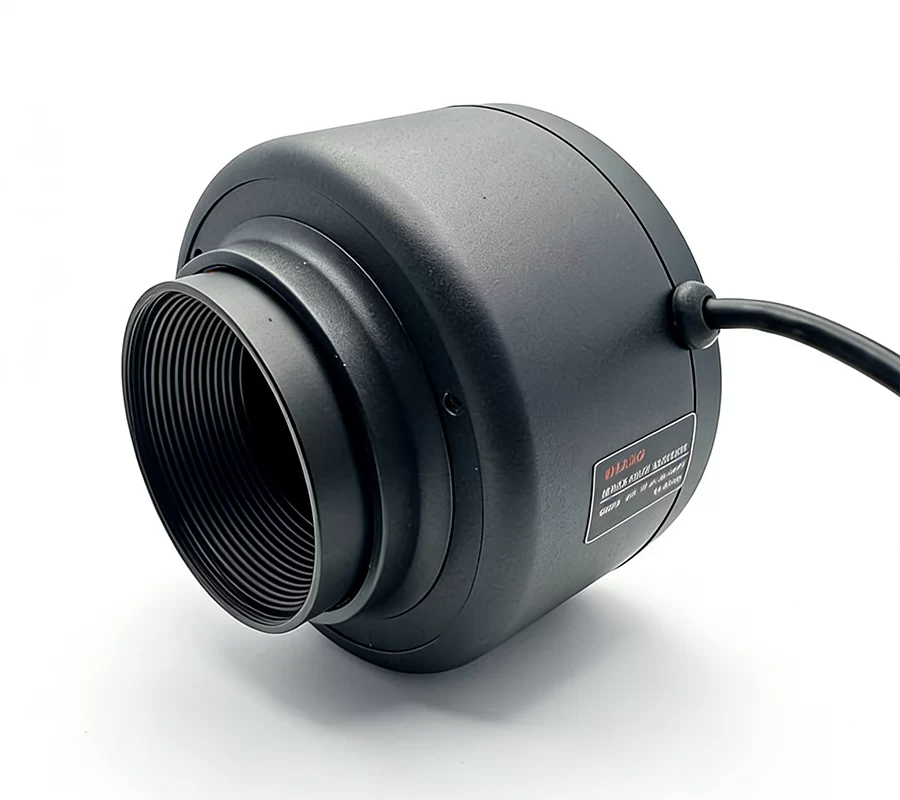
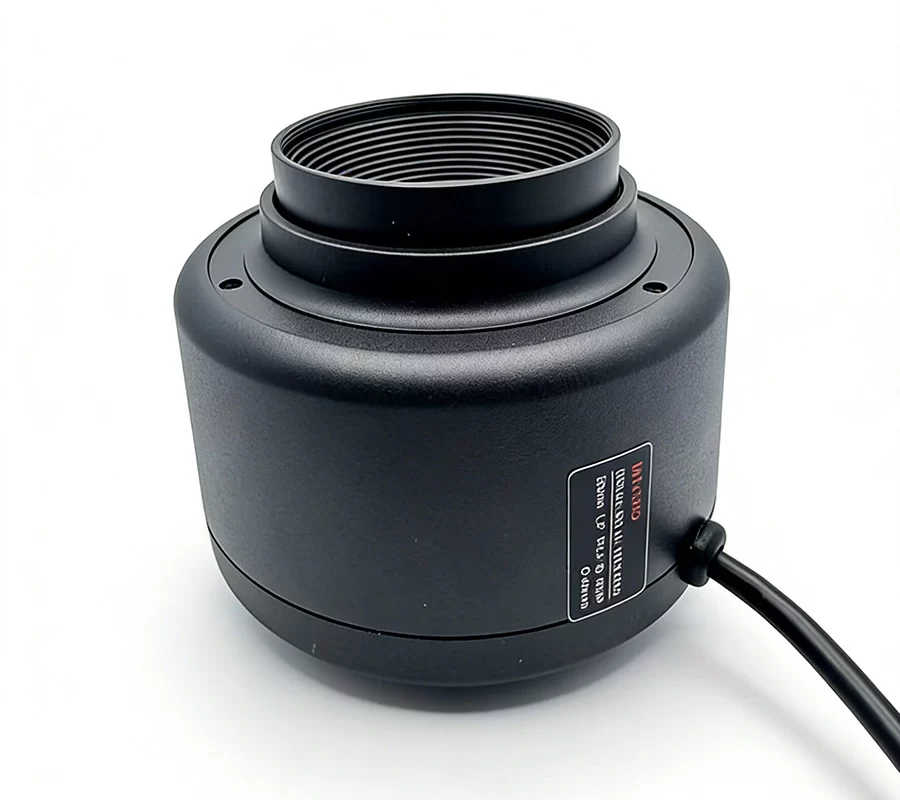
Walk the floor of any machine vision trade show and you will find nearly identical-looking FA lenses at very different prices. More often than not, the difference is not the glass: many motorized lenses share the same optical platform as their manual siblings — the same lens groups, the same coating design, the same nominal MTF. What the premium buys is the focus mechanism and the tolerances built around it: a motor, a closed-loop position encoder, and a control interface. So the right question is not “which lens is better?” but “does my station need what the motor buys me?” This article answers that with four scenarios where motorized focus is essentially mandatory, two where manual focus is the smarter buy, an honest account of what motorization costs over a lifetime, and a simple way to find your own crossover point.
What Are You Actually Paying For?
In a manual FA lens, you turn the focus ring once at commissioning, tighten the lock screw, and the lens sits there for years. The mechanism is simple, robust, and cheap — and for many stations, that is all it needs to be.
A motorized version of the same optics adds:
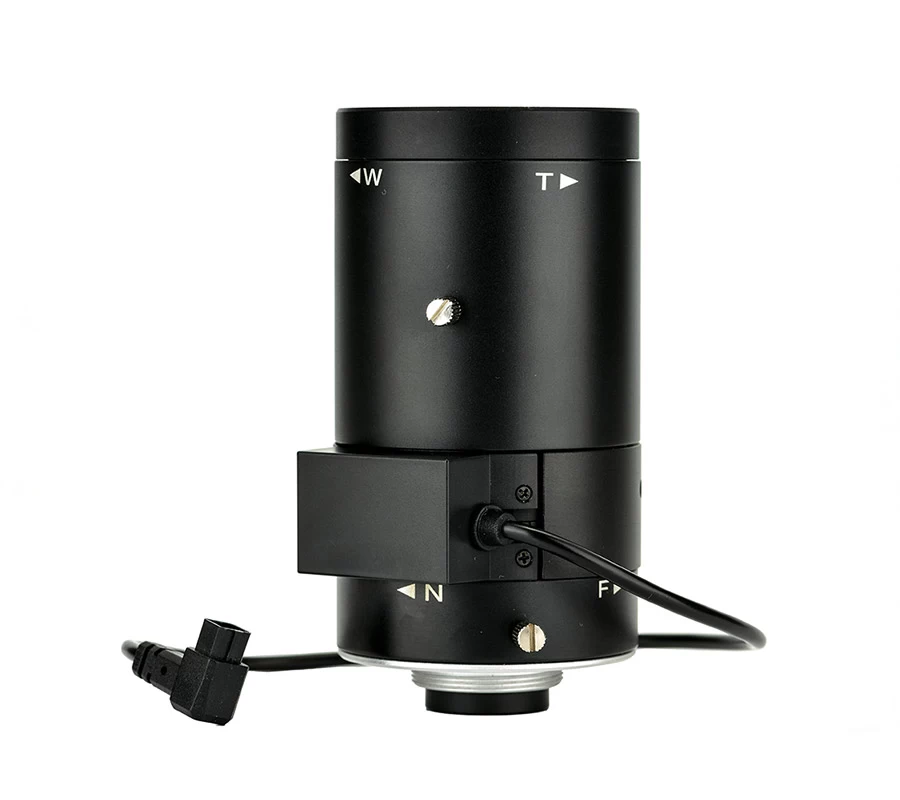
A precision drive — preloaded to minimize backlash — that moves the focusing group electronically.
Closed-loop encoding. The controller reads back the actual focus position, not merely the command it sent. That is what makes the position repeatable: command focus value 340 and the optical group returns to exactly the same place, every time, after every move. One question worth asking before you specify: is the encoder on the motor shaft or on the moving group? Shaft-mounted encoders cannot see leadscrew backlash or carriage stiction, and they need a homing move after every power loss — group-mounted feedback (linear scale or absolute encoder) does not.
A control interface (serial, USB, or I/O) so the vision system or PLC can command focus positions by recipe.
This is why a motorized lens costs more even when the optics are identical: the added cost sits in mechanics and electronics, not glass. But “shared platform” is a statement about the design, not about every unit that ships. In volume, three things still differ and must be verified per version: the decenter and tilt tolerance of the moving focus group (a helicoid and a motorized carriage are not built to the same numbers), stray-light paths introduced by the drive cavity, and thermal defocus from the added heat source — which this article itself flags further down. Judge both versions by measured MTF and ghost measurements, not by the shared design.
Four Scenarios Where Motorized Focus Pays Off
• Working distance changes on the line (multi-product, multi-SKU). If your station inspects products of different heights or sizes — e-commerce packaging, mixed-SKU trays, family-of-parts machining — the nominal working distance changes with the recipe. With manual lenses, every changeover means stopping the line and re-teaching focus by hand. With a motorized C-mount lens, changeover is a focus value in the recipe, applied in milliseconds between products. The more variants you run, the faster the premium pays back.
• Remote maintenance and unattended equipment. Machines shipped to customers, installed inside sealed enclosures, or deployed on another continent cannot be refocused with a screwdriver. A motorized industrial lens lets a service engineer — or the customer’s own technician — restore correct focus remotely in seconds. For equipment builders, this alone frequently justifies the upgrade: it converts an on-site service visit into a remote command.
• Focus tracking and ROI-based autofocus. Some applications need focus to move during operation: depth-encoded z-stacking for tall objects, autofocus inside a region of interest while parts wander, or following a robot’s programmed standoff as it moves. None of this is possible when focus is fixed by hand; all of it is straightforward when the vision system owns the focus axis electronically.
• Multi-camera fleets under recipe control. A machine with 8–20 cameras, each needing a slightly different focus per product family, becomes a maintenance burden if every lens is manual: every changeover turns into a manual alignment session across the whole machine. Motorized lenses turn the fleet into recipe-driven parameters — focus positions stored per product, restored identically on every machine, every time. Closed-loop repeatability is what makes camera #7 behave like camera #1.
Two Scenarios Where Manual Focus Still Wins
• One fixed station, one product, one height. If fixturing pins the working distance and it never changes, focus is set once and locked. A motorized lens here is a motor that never turns — pure added cost, plus one more electronic part that can fail. Choose the manual version with a firm lock screw and standardize on it.
• Cost-sensitive, high-volume machines with accessible mechanics. For compact, single-purpose machines built in volume — where the focus ring is reachable and the BOM is scrutinized per unit — the manual lens keeps cost and complexity down. What matters here is discipline, not electronics: document the focus setting, verify it after any lens change, and lock the ring.
The Honest Trade-off: What Motorization Costs Over a Lifetime
An honest comparison cannot list only what the motor adds. Before specifying electric focus across a machine, account for four real costs:
• Power and heat. A motorized lens draws current and dissipates heat right next to the optical path. In a sealed enclosure with several powered lenses, self-heating shifts focus and magnification measurably until thermal equilibrium; closed-loop encoding and a warm-up/focus-after-settle discipline keep this under control, but it has to be designed for, not assumed away.
• Control and integration complexity. Serial addresses, cable routing, EMC, driver/API versions and PLC programming all become part of the project. A fleet of motorized lenses is a small network: it needs documentation, commissioning time and an integrator who understands it.
• Failure modes and spares. The manual lens has essentially one part that can fail. A motorized lens adds motor, encoder, gear/drive and flexible cable — each a long-tail failure item after years of cycling. Plan for spares and for firmware/driver lifecycle, not just the purchase price.
• Lifetime maintenance and total cost. Total cost of ownership includes cabling, controllers, periodic verification of repeatability, and firmware management. On a station that changes focus twice a year, these costs never come back — which is exactly why the crossover math matters.
This is also why we do not recommend motorizing by default: on a fixed station the honest engineering answer is a manual lens with a good lock, and the motor should be bought only where the use case cashes it out.
Motorized vs Manual: Quick Decision Table
Situation | Recommended choice |
|---|---|
Working distance changes with product/batch | Motorized |
Station sealed, remote, or hard to reach | Motorized |
Focus must move during operation (z-stack, ROI AF) | Motorized |
Multi-camera machine, recipe-driven changeover | Motorized |
Single fixed station, single product | Manual + lock |
Volume machines, accessible focus, tight BOM | Manual + lock |
Run the Numbers: Finding Your Crossover Point
The payback logic is simple arithmetic:
Annual time cost = changeovers per year × minutes per manual re-focus × downtime cost per minute
Then compare it against the motorization premium per camera plus the added power, control and maintenance cost above.
Example: a mixed-SKU line changes over 40 times a day, and a manual re-focus across four cameras takes 5 minutes. That is roughly 200 minutes of daily downtime. Even at a conservative downtime cost, an electric-focus upgrade — which cuts each changeover to seconds — typically pays for itself within weeks. Conversely, a station that changes over once a month will wait years to recover the premium: buy manual and spend the difference on lighting.
If you share your changeover frequency and camera count with us, we will run this crossover calculation for your production mix — including the lifetime terms, not just the lens price.
Forward View: The Focus Axis Goes Connected
Motorized focus is converging with the wider IIoT and Industry 4.0 stack, and four implications are already practical:
• Focus as a remotely managed asset. Lenses are gaining networked control and health telemetry — position, drive temperature, cycle counts — so focus can be audited and restored from anywhere and serviced predictively rather than after a drift escapes.
• Recipe-driven, traceable focusing. Focus values join exposure and lighting in the per-product recipe and are logged per part, supporting traceability and SPC in regulated lines. The same data is becoming training input: a virtual camera model is only as good as the per-unit MTF and distortion spread behind it, which is why measured per-unit data is turning from a quality record into an asset.
• Closed-loop focus tied to measurement. Autofocus fed by sharpness or distance feedback closes the loop on the actual image, not just an encoder count — useful as parts and carriers vary.
• Interoperability standards. As GigE Vision/GenICam-style control and vendor-agnostic device profiles extend to lens peripherals, swapping a motorized lens will increasingly mean loading a configuration rather than rewriting integration code.
If you are still selecting the lens itself, our C-mount FA lens checklist covers the seven steps that come before the focus mechanism question. Our product direction follows this path: same-platform manual and motorized FA lenses (such as the 8 mm and 0.5× pairs) with closed-loop encoding and per-unit repeatability verification, so the connected focus axis is designed in from the start rather than retrofitted.
FAQ: Motorized FA Lenses
Q1: Does a motorized lens have worse image quality than the manual version?
Not on a shared optical platform. The glass, coatings, and optical design are identical; only the focus mechanism differs. Judge both versions by the same MTF curves.
Q2: What does “closed-loop” mean in a motorized FA lens?
The controller verifies the actual focus position via an encoder rather than trusting the command. This delivers repeatable positioning — the same commanded value always yields the same focus — which recipe-driven changeover depends on.
Q3: Can I upgrade a manual installation to motorized later?
On a same-platform family, yes — without re-qualifying the optics or redesigning the machine. Expect one single-scale recalibration after the swap: field of view and magnification are functions of the focus position, so any change in where the group parks invites a fresh pixel-scale check. Qualify the optics once, then choose the mechanism per station.
Q4: How is focus controlled on the production line?
Through a serial/USB interface or I/O from the PLC or vision controller: focus positions are stored in the product recipe and applied automatically at changeover or between parts.
Q5: Does motorization add heat that shifts the image?
It adds some, yes — which is why closed-loop positioning, warm-up and focus-verify-after-settle matter in sealed, multi-lens enclosures. Specify your duty cycle and ambient range; we provide thermal guidance per platform.
Same Platform, Drop-In Upgrade
Josight builds its motorized and manual FA lenses on the same optical platforms — the 8 mm motorized and manual versions, and the 0.5× motorized and manual versions, share identical lens design and coatings. Each motorized unit ships with its own closed-loop repeatability verification, not just a type specification. That means:
You qualify the optics once, then choose the focus mechanism per station.
A manual installation can later be upgraded to motorized without re-qualifying the optics — plan on one single-scale recalibration, since magnification depends on the focus position.
Comparing the two is a true apples-to-apples exercise — which is exactly why we publish a side-by-side datasheet.
Ask for the Same-Optics Comparison Datasheet
Josight provides a same-optics comparison datasheet covering the 8 mm and 0.5× motorized/manual pairs — optical performance curves side by side, plus drive interface and repeatability specifications. Ask for it, and if you share your station’s changeover frequency and camera count, we will show you exactly where the crossover between manual and motorized sits for your production mix.
Disclaimer
The information provided in this blog post is for general informational purposes only. Lens specifications, performance data, and product availability are subject to change without notice. Actual performance may vary depending on application conditions, system configuration, and environmental factors. Josight makes no warranties, express or implied, regarding the accuracy, completeness, or suitability of the information contained herein. Readers should conduct their own testing and validation before making procurement decisions.