The lowest quote rarely tells the whole story.
Anyone who has sourced optical components from overseas knows the price spread can be staggering. One supplier quotes $15 per lens. Another quotes $45. Six months later, the “bargain” lens may have cost you far more in rework, line downtime, and damaged customer relationships.
Price matters. It is just not the only thing that matters.
Key takeaways
• When quotes differ by 3×, check one thing first: whether the supplier owns its production line. It is the hardest line between a factory and a trader — more telling than any certificate.
• “We have QC” is not data. Serialized, per-unit MTF and distortion reports are what you can accept against; a typical curve only tells you what a prototype achieved.
• Certifications show intent; audit history shows execution. IATF 16949 is materially stricter than ISO 9001 on change management and traceability — but neither one guarantees zero defects.
• A supplier who says “we don’t do that” is more credible than one who says yes to everything. Even a fully integrated factory has material and size limits.
Criterion 1: Do they have in-house manufacturing capability?
This is the single most important differentiator between a factory and a trader.
What in-house capability means:
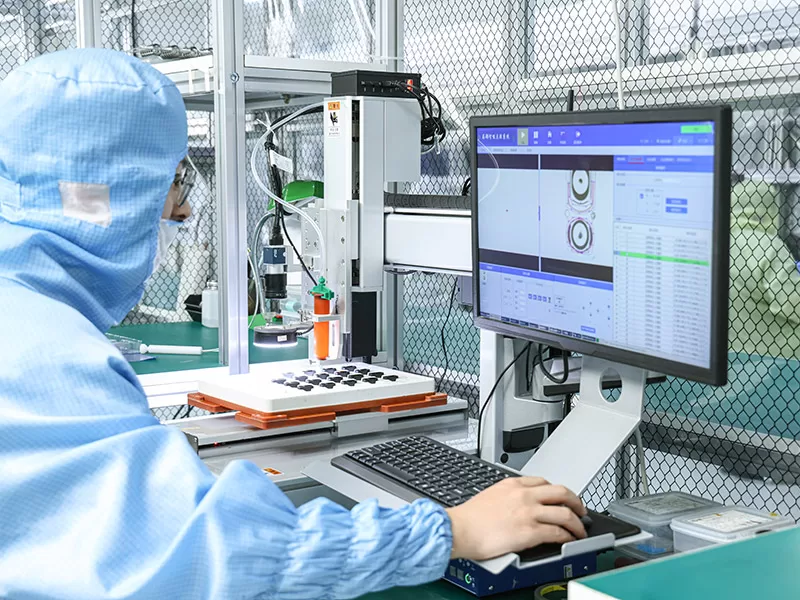
• Grinds and polishes optical elements on their own equipment.
• Applies multi-layer coatings in their own vacuum chambers.
• Assembles, aligns and tests finished lenses in their own facility.
• Can trace problems to the exact process step and fix it, rather than relaying messages between you and a subcontractor.
Why it matters: direct quality control, predictable lead times, faster design changes.
How to verify: factory photos or a tour video, an equipment list, and the business-license address checked against the plant address.
⚠ Red flag: the supplier lists dozens of unrelated product categories — likely a trading company.
Criterion 2: What does their “quality control” actually include?
Level | What it looks like |
|---|---|
Basic | Visual inspection: scratches, chips, dirt |
Intermediate | Dimensional metrology: center thickness, diameter, surface figure |
Advanced | Optical testing: MTF, eccentricity, SFR, interferometry |
Comprehensive | All above + environmental testing + batch traceability |
For precision optics, you want minimum Level 3 (Advanced).
Questions to ask: “Can you send me a sample MTF report?” “100% inspection or AQL? At what level?” “Do you keep test records per batch?” “What is your root-cause analysis process for failures?”
Then go one step further: ask whether the report is measured per unit, with a serial number, or merely a “typical curve.” In metrology and high-resolution work, a datasheet describes a prototype; a per-unit report describes the exact lens you will receive.
Criterion 3: Certifications and audit history
Minimum expectation: ISO 9001 — any serious manufacturer should have this.
Strong signal: IATF 16949 — far stricter than ISO 9001 in process control, change management and traceability.
Even stronger signal: Customer audit history — 30+ completed audits, especially from global companies in developed markets.
Certifications show intent. Audit history shows execution.
Criterion 4: Transparency from sample to volume
Good signs: DFM review before quoting; a clear sample approval process; a pilot run (10–100 pieces) before full volume; proactive batch-consistency communication.
Red flags: Sample perfect, first volume batch drifts; no pilot run — straight from one sample to 10,000 pieces; cannot explain the process or show a flowchart.
Criterion 5: Technical support beyond the sale
What to look for: Application engineering support — help select the right lens, not just quote it; a problem-solving partnership — analyze root cause, not assign blame; data-sharing willingness — MTF curves, test reports, coating spectra.
A supplier that hides behind “trust us” should be approached with caution. One that shares data and process is worth building a long-term relationship with.
Criterion 6: Future-proof capability — digital quality and co-design
If your product will iterate for years, alongside the five classic criteria it is worth examining two “future capabilities” early:
• Digital quality traceability. Can each lens be linked to its blank batch, coating chamber run, assembly and inspection records? IIoT and Industry 4.0 are turning quality data from paper archives into something delivered with the goods and retrievable remotely. When a field issue surfaces on another continent, pulling up that lens’s original test data remotely — versus chasing emails — is a fundamentally different experience.
• Optics–algorithm co-development. With the rise of computational imaging, multispectral and 3D vision, the most valuable suppliers no longer merely build to drawing (the underlying trade-offs are set out in our machine vision optics guide); they jointly make imaging-chain trade-offs early (how MTF matches Nyquist, how coatings match the band). A factory with cold processing, coating and assembly under one roof iterates this kind of co-design far faster — the capability a trader can least easily fake.
• Headroom for high-resolution processes. With pixels at 2.x μm and sensors heading to 50 MP, demands on decenter, air spacing and coating consistency multiply. Asking “what is the highest resolution / smallest pixel you ship stably in volume today?” tells you more than any brochure image.
• Supply-chain resilience. Cross-border volatility is now normal. A manufacturer integrating cold processing, coating and assembly on one campus carries materially less lead-time and change-control risk than a multi-tier outsourced chain.
In fairness: every supplier — including us — has limits
An article on screening suppliers would be dishonest if it portrayed manufacturers as all-capable. A few points deserve to be made up front:
• Certification is not zero defects. IATF 16949 and ISO 9001 evidence a system and an intent, not perfection in every unit; the real assurance is per-unit testing, batch traceability and the response when something fails. An audit certifies the state of the system on that day; ongoing consistency still has to be proven with data.
• Even an integrated factory cannot do everything. No line is without process and size limits — exotic materials (some SWIR crystals), extreme apertures or specialty coatings may still require specialist cooperation. A mature supplier tells you plainly “we don’t do this / it needs joint development,” rather than accepting the order and quietly outsourcing it.
• Bigger is not always better. A giant supplier may move slowly on low-volume, fast-iteration custom projects; a small specialist house may lack the systems for large-volume consistency. The supplier that matches your project stage and volume is the optimum.
• Neither the lowest nor the highest price is itself a quality signal. Low prices carry hidden risk, but high prices can just as easily be brand premium. Only data speaks for itself: MTF reports, batch records, audit history and measured samples.
About Josight (briefly)
Josight is the international brand of an optical manufacturing group based in Chengdu, Sichuan, China. Three operating entities collaborate on one integrated campus:
• Cold processing and polishing — singlets, doublets, prisms, windows; spherical and aspheric surfaces.
• Multi-layer vacuum coating — 10 coating systems covering 380–1100 nm (standard) and IR bands (custom).
• Lens assembly and testing — FA, telecentric, line scan and custom lenses, with per-unit MTF, eccentricity and SFR testing.
Facility: 9,000 m², 300+ staff. Certifications: IATF 16949 + ISO 9001. 50+ granted patents, 30+ customer audits completed.
We are transparent about what we can do, honest about what we cannot, responsive when issues arise — and happy to tell you early in a project when a different approach would serve you better.
FAQ
Q1: How do I quickly tell a Chinese optical manufacturer from a trading company?
Three checks. First, compare the address on the business license with the actual plant address. Second, ask for an uncut production-line video — cold processing through coating, assembly and testing in one continuous take, not a highlight reel. Third, ask one specific process question, e.g. “What is your measured peak transmission on a 940 nm narrowband filter, and on which coating chamber was it run?” A trader can usually produce a quote; it cannot produce a chamber-run record.
Q2: What does IATF 16949 actually buy me when sourcing optics?
It buys you “changes will not happen silently.” IATF 16949 requires documented change management, production-part approval (PPAP-style), traceability and an evidence trail of continual improvement. In optical terms: when the supplier changes a glass grade, a coating run or a polishing process, you must be notified in writing and re-qualify — rather than discovering it when incoming MTF drops. ISO 9001 does not carry that force.
Q3: Samples look great, volume drifts. How do I prevent that contractually?
Write three clauses. (1) Use first-article measured data as the acceptance baseline and compare every lot against it, instead of re-sampling each batch. (2) Any change to a critical process step — glass melt, coating run — requires written notice and re-submitted samples. (3) Define critical (CR) characteristics as zero-defect and the rest by AQL. Also require a pilot-run (10–100 pcs) versus first-volume comparison table: it is the step most often skipped, and the one that exposes drift earliest.
Q4: What is the most overlooked cost in cross-border sourcing?
Not freight — change cost and re-validation cost. Changing a glass grade can trigger a full MTF and environmental re-qualification; changing a coating run can shift transmission across a whole lot. Ask a prospective supplier, “how many process changes per year go out without advance notice to the customer?” It is a more useful question than the unit price.
Q5: Is an integrated factory always better than a multi-tier supply chain?
Not always — it depends on your volume and customization. Integration wins on change response and traceability closure; for very large volumes of standard parts, a specialized chain may still win on cost. The real question is: when something goes wrong, who can trace it to the exact process step and issue corrective action within a week?
Evaluating suppliers? Here is our invitation.
We welcome factory audits — in person or via video tour. We are glad to send test samples, per-unit MTF reports or measured coating spectra, and can first run a no-preconclusions capability comparison for you.
Disclaimer
The information in this article is provided for general informational purposes only. Lens specifications, performance data and product availability are subject to change without notice. Actual performance may vary with application conditions, system configuration and environmental factors. Josight makes no warranties, express or implied, regarding the accuracy, completeness or suitability of the information herein. Readers should conduct their own testing and validation before making procurement decisions.