Key Takeaways
A liquid lens changes focal length by reshaping a liquid surface electronically — no moving mechanical parts, no wear.
Focus settles in single-digit milliseconds, fast enough to be triggered inside the normal image cycle by a PLC.
One liquid lens can focus continuously from 0.1 m to infinity, replacing a shelf of fixed-focus lenses.
It is not a zoom: framing is set by the host lens, and the cell adds electronic focus. Magnification does shift slightly with focus position — about 16% at 0.1 m relative to a helical focus at the same working distance — so for dimensional work the pixel scale has to be re-established at each focus value.
• Wavelength matters: water-based electrowetting fluids are usable from about 400–900 nm, marginal at 940 nm, and effectively opaque by 1450 nm. Ask for measured transmission at your wavelength, not a visible-band curve.
What Is a Liquid Lens?
A liquid lens is a variable-focus optical element that changes optical power by reshaping a liquid surface — not by moving glass. Electrowetting is the dominant commercial architecture, but it is not the only one. Four families are in production today: electrowetting (two liquids, voltage changes wall wettability), membrane or polymer cells (fluid behind a deformable membrane pushed by a voice coil or ring actuator), liquid-crystal lenses (a voltage-driven refractive-index gradient across an LC layer), and Alvarez or tunable-diffractive plate pairs (two specially figured plates slid across each other). They differ sharply in clear aperture, power range, polarization behavior and usable band. What follows describes the electrowetting type, which is the architecture behind most C-mount liquid lenses.
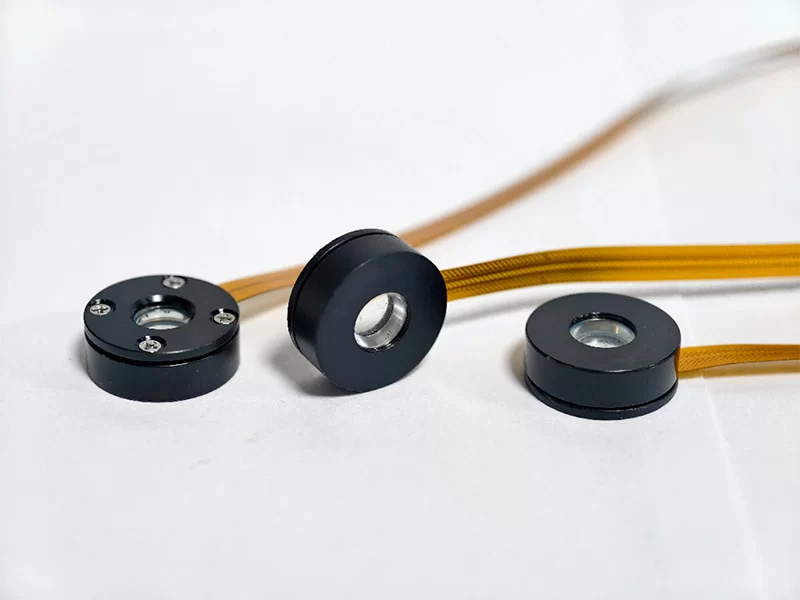
Inside a sealed cell a few millimeters across, a conductive aqueous liquid and an insulating oil meet at a curved boundary called the meniscus. That meniscus behaves like an optical surface: light refracts at it exactly as it would at a glass element. Change its curvature, and you change the focal length — instantly, repeatably, and without any mechanical motion.
If you are still choosing the host lens, our C-mount FA lens checklist covers the seven steps that decide the optics the cell will sit behind. For machine vision, that single difference rewrites the rules of focusing. Traditional autofocus must physically move a lens group, which takes time, wears out, and drifts. A liquid lens does none of these things. It is already transforming continuous inspection on high-speed production lines, where stopping to refocus is no longer acceptable.
How Does a Liquid Lens Work? Electrowetting, Explained
The operating principle is electrowetting. Apply a voltage across the cell and the wettability of the inner wall changes, which pulls the meniscus into a different curvature. Steeper curvature produces a shorter focal length; flatter curvature produces a longer one. Remove the voltage and surface tension restores the original shape.
Three properties follow directly from this physics:
No mechanical travel. Nothing slides or rotates, so there is no gear wear, no stick-slip and no lubricant to migrate. Focus is set by surface tension against voltage. Speed, though, is not one number: a small step between adjacent focus values settles in roughly 1–5 ms, while a full-stroke move on a large-aperture cell can take 10–30 ms. Both are inside a frame interval at typical line rates — but specify it as a step response at a stated aperture, not as a headline figure.
Continuous range. Every focal length between the minimum and maximum curvature is available. Focus stops being a set of discrete positions and becomes a continuously addressable parameter.
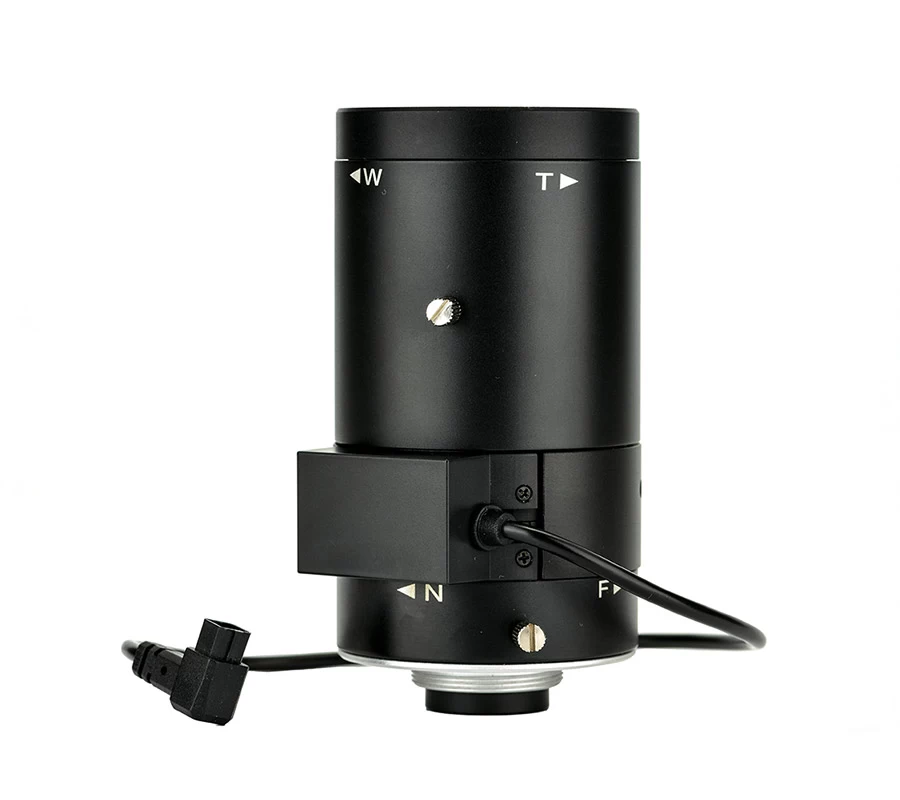
Solid-state integration. The liquid lens is a compact sealed cell that mounts within a conventional C-mount lens. It complements standard optics rather than replacing them.
Why Millisecond Focusing Is a Step Change for Continuous Inspection
On paper, “fast autofocus” sounds like a convenience. On the production floor, it is a category change.
The line never has to stop. Conventional autofocus works like this: detect blur, drive a motor, wait for settle, confirm, then accept the part. Each cycle costs hundreds of milliseconds to seconds. On a line running hundreds of parts per minute, the line either pauses to focus — or out-of-focus parts are simply missed. A liquid lens settles in milliseconds, so focus can be corrected inside the normal image cycle, triggered by the PLC like any other I/O. There is no mechanical settle time to budget for.
Varying-height workpieces stop being a problem. Packages on a conveyor do not arrive at identical heights, and parts in a dunnage bin certainly do not lie flat. A conventional station either engineers the variation away with fixturing or loses focus. With a liquid lens, the focus value for each part height is read from the product recipe and applied between frames — every part is imaged in focus, wherever it sits.
Focus becomes a predictable, schedulable resource. With no motor there is no wear, no backlash, and no thermal drift from a drive train to keep re-learning. Vision engineers can time-budget focus exactly the way they time-budget exposure and lighting.
Liquid Lens vs. Traditional Autofocus
Attribute | Liquid lens | Motorized traditional lens |
|---|---|---|
Focusing principle | Curvature change (electrowetting) | Moving lens group |
Settle time | Single-digit milliseconds | Hundreds of ms to seconds |
Mechanical wear | None | Motor, guides, gears |
Focus range | Continuous (e.g., 0.1 m – ∞) | Limited helicoid travel |
Cycle-life repeatability | No wear mechanism; qualified in hundreds of millions of cycles | Degrades with wear |
Field of view | Set by host lens; narrows at close focus | Fixed by lens design |
The comparison makes the positioning clear: a liquid lens wins wherever focus must change frequently and quickly; a motorized lens remains a sound choice where focus changes only at changeover.
From 0.1 m to Infinity: One Lens Replaces a Shelf of Lenses
A conventional fixed-focal lens is sharp at one working distance and degrades rapidly as the object moves away from it. Covering inspection points from 100 mm to several meters has traditionally meant multiple cameras — or swapping lenses by product family.
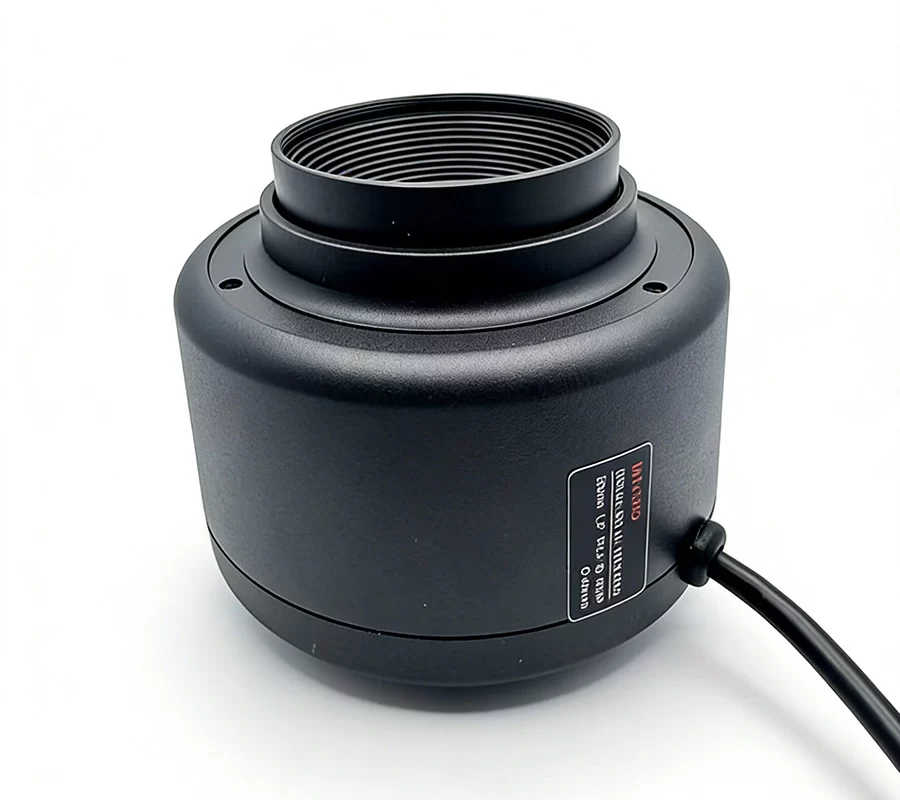
A liquid lens collapses that range. The Josight JOS311001640A 16 mm liquid lens focuses continuously from 0.1 m to infinity in a standard C-mount package. Worth knowing what that costs optically: reaching 0.1 m from a 16 mm prime takes about 10 diopters of added power — the equivalent of pulling the image plane back roughly 3 mm and shortening the effective focal length to about 13.8 mm. Three consequences follow. The field of view narrows at the near end, as it does for any lens focused close. Each feature then covers proportionally fewer pixels, so the pixel scale must be rebuilt per focus position. And the aperture you can reach is set by the cell, not by the host lens. What this means in practice — plus a one-line check you can apply to any focal length: the magnification loss is numerically equal to f/u, which is exactly the magnification at that working distance (m_cell / m_helical = 1 − f/u), while the linear field ratio is 1/(1 − f/u). A “16% loss at 0.1 m” only sounds large because m is already 0.16 there. This is a first-order bound; a real trace departs from it because the cell does not sit at the principal plane.
One camera design covers many SKUs. The same station handles close-range label inspection and longer-range logistics reading by changing a focus register, not hardware.
Leaner inventory and spares. One lens model on the shelf instead of five focus variants of the same focal length — but not instead of five focal lengths, since framing is still fixed by the host optics.
Faster commissioning. A new product equals a new focus value in the recipe — not a mechanical re-teach.
Where Liquid Lenses Deliver the Most Value
Variable-height production lines — food, pharma, and e-commerce packaging, where products arrive at inconsistent heights and the line cannot pause.
Bin picking and logistics — parts and parcels at unpredictable depths inside totes and on belts.
Code reading and traceability — DPM and 1D/2D codes across a depth range that would otherwise demand several fixed-focus stations.
Focus stacking for deep objects — several frames at different focal lengths fuse into one fully sharp image.
Robot-guided inspection — as the robot moves, focus tracks the programmed standoff electronically.
What a Liquid Lens Cannot Do: The Honest Engineering Boundaries
An honest technology brief needs boundaries, and liquid lenses have real ones. None of them disqualifies the technology for its target jobs, but all of them should be designed around:
• It is not a zoom, and framing is not perfectly constant. Field of view is set by the host optics, so changing framing still means changing the lens or moving the camera. But focus and magnification are coupled: a lens that focuses by changing its power rather than by moving a group behaves like a slightly different focal length at each focus position. At the same working distance, the JOS311001640A is 16 mm with a helical focus and about 13.8 mm with the cell — a −16% magnification difference at 0.1 m and −1.6% at 1 m, with a correspondingly wider linear field at the near end and fewer pixels per feature. It is a symmetric trade-off, not a free lunch: for dimensional measurement, re-establish the scale at every focus position.
• Aperture is capped by the cell’s clear aperture — do the arithmetic, and publish both numbers as a pair. Josight’s tunable 16 mm host is specified at f/4.0 with a 4 mm-class clear aperture, and the two figures have to agree: focal length ÷ clear aperture is the F-number, so 16 ÷ 4 ≈ f/4.0. Not because the host lens is slow, but because the cell is itself the limiting aperture. Reaching f/2.8 would need about 5.7 mm of clear aperture — a larger cell or a longer focal length. Give the pair (clear aperture Ø / f/#) rather than the F-number alone: an engineer’s first move on seeing one is to divide it into the focal length to check it against the other. Either way, extreme low-light work that still needs f/1.4–f/2 glass belongs to conventional fast primes — budget your illumination accordingly.
• Resolution is capped by the host lens — and slightly loaded by the cell. The liquid cell adds two refracting surfaces and fluids of finite optical quality. In a well-integrated assembly the impact on MTF is small, but a liquid lens can never out-resolve the fixed-focal optics around it. For the highest-resolution 2.x µm-pixel sensors, check measured MTF across focus positions rather than relying on the host lens curve alone.
• Transmission is set by the fluid *and* the window coatings — both matter. Water-based electrowetting fluids are usable from roughly 400–900 nm. At 940 nm, close to water’s 970 nm overtone absorption, the fluid alone costs about 4–6% over a 2–3 mm path (8–11% at 4 mm). On top of that, the cell’s four window surfaces must be specified for the near-IR. Our own broadband AR measures ≤1% per surface at 940 nm, so four interfaces cost about 4%; add the 4–6% fluid absorption and the assembly lands at roughly 8–10% total loss at 940 nm — a number worth putting in your light budget rather than guessing at. Leave the coating unspecified and the interfacial term climbs sharply instead: that gap is the cost of specifying the wrong coating, not a property inherent to liquid lenses. Beyond about 1.2 µm performance degrades quickly, and by 1450 nm the fluid is essentially opaque. If your application is SWIR, a liquid lens is the wrong actuator — use a motorized or piezo stage instead.
• Temperature sensitivity. Fluid properties (refractive index, viscosity, surface tension) shift with temperature, so the diopter-versus-drive-voltage curve drifts and, at the extremes, settle time can lengthen. Industrial implementations use temperature compensation in the driver and closed-loop or look-up-table calibration; specify your operating temperature range and ask for data across it. A bare module without compensation is a lab device, not a production component.
• Long-term reliability and fluid aging. Sealed cells have proven robust over hundreds of millions to billions of cycles and years of field use, but engineers should still demand qualification data for their conditions: accelerated life, thermal cycling, shock/vibration, and storage range. Fluid chemistry and sealing have improved markedly; they are not magic.
• Close-focus geometry and gravity. At the near end of the range the optical power is high and depth of field is thin, so focus accuracy tolerances tighten; electrowetting cells are largely gravity-insensitive (an advantage over some membrane designs), but orientation and shock should still be validated in the actual mount.
Positioning it precisely: a liquid lens is a fast, wear-free focus actuator, not a faster, brighter, sharper lens. It removes the time and wear cost of changing focus; it does not remove the fundamental trade-offs of the optical path.
Where Tunable Optics Go Next
Liquid focusing is one branch of a broader move toward tunable optics, and several directions are already visible:
• Hybrid focusing. Liquid cells are being combined with voice-coil or piezo groups to cover both fast fine focus and larger optical-power ranges, and with computational-focus pipelines that fuse a burst into an extended-DOF image.
• Competing and complementary tunable technologies. Membrane/polymer lenses, tunable apertures, and tunable diffractive/Alvarez elements are improving in parallel; the right element increasingly depends on aperture, power range and bandwidth rather than a single winner.
• Embedded closed-loop control. Drivers are integrating temperature sensing, position/diopter feedback and per-unit calibration, so a focus command means the same diopter at 5 °C and 45 °C — turning the cell from a component into a calibrated smart actuator.
• Recipe-driven, Industry 4.0 integration. Focus is becoming just another parameter in the product recipe, logged per part and synchronized with lighting and gain; expect focus data to feed SPC and traceability the way exposure data does today.
Our own development follows the same logic: the useful product is not a liquid cell bolted onto an existing lens, but one co-engineered optical system — coating interfaces included — whose MTF is characterized at multiple focus distances and whose compensation is validated across the industrial temperature span.
FAQ: Liquid Lenses in Machine Vision
Q1: How fast does a liquid lens focus?
Typical settle times are in the single-digit milliseconds — fast enough for focus to be applied between frames under PLC control, with no mechanical settling.
Q2: Does a liquid lens wear out?
There are no moving mechanical parts. Focus is set electrostatically against surface tension, so repeatability is maintained over hundreds of millions to billions of cycles. The fluids and seal still age slowly, so request accelerated-life and temperature-cycle data for your operating conditions.
Q3: Can a liquid lens replace my FA lens?
No — and it is not meant to. The liquid lens sits within a conventional fixed-focal lens and adds continuous electronic focus. Resolution and field of view still come from the host lens.
Q4: What is the difference between a liquid lens and a varifocal lens?
Both change optical power — the difference is mechanism and purpose, not principle. A varifocal lens shifts focal length mechanically over a limited range and is re-set by hand at changeover; framing changes, so it needs re-calibration. A liquid lens changes power electronically in milliseconds and continuously, is built for in-cycle autofocus, and is normally used to hold framing while focus tracks. The practical distinction is repeatability and speed, not whether magnification moves.
Q5: Which applications benefit most?
Any station where working distance varies part to part: mixed-height packaging, bin picking, deep-DOF code reading, focus stacking, and robot-guided inspection.
Q6: How does temperature affect it?
Fluid properties shift with temperature, moving the diopter-per-volt curve and, at extremes, slowing settling. Industrial modules compensate in the driver and are calibrated over temperature; always specify and test at your real ambient range.
Q7: Can I use a liquid lens at 940 nm, or in SWIR?
940 nm is workable but has to be budgeted: water absorbs near 970 nm, so expect roughly 4–6% loss across a 2–3 mm fluid path; add four NIR-specified window interfaces at ≤1% each and the cell lands around 8–10% total loss at 940 nm. Ask the supplier for measured transmission at 940 nm rather than a visible-band curve, and build the figure into your light budget. Beyond about 1.2 µm transmission falls quickly and by 1450 nm the fluid is essentially opaque, so SWIR imaging needs a different actuator entirely.
Q8: Is focus speed really single-digit milliseconds?
It depends on aperture and how far the focus has to travel. Small steps between adjacent focus values settle in about 1–5 ms; a full-stroke move on a large-aperture cell can take 10–30 ms. Both fit inside a frame interval at typical line rates, but specify it as a step response at your aperture and your diopter swing — a single headline number is not reproducible.
Getting Started with the JOS311001640A
The JOS311001640A integrates a 16 mm fixed-focal optical path with an electronically controlled liquid lens, covering 0.1 m to infinity through a standard C-mount. Because the cell and the glass are co-engineered and the fluid interfaces carry our own multi-layer coatings, it behaves as one balanced system rather than a host lens plus an add-on — and we publish measured MTF at multiple focus positions rather than quoting only the bare-lens curve. It installs like a lens and drives like an actuator: focus commands over a standard control interface, temperature-compensated millisecond settling, and no mechanical wear.
If you are evaluating variable-focus inspection for the first time, the fastest path is to run it on your own targets.
Request the Liquid Lens Evaluation Kit
Josight offers a liquid lens evaluation kit — JOS311001640A module, controller and integration guide — so your team can measure focus speed, image quality across focus positions, and temperature behavior on your actual production targets. Request the kit and our application engineers will help you define the test plan.
Disclaimer
The information provided in this blog post is for general informational purposes only. Lens specifications, performance data, and product availability are subject to change without notice. Actual performance may vary depending on application conditions, system configuration, and environmental factors. Josight makes no warranties, express or implied, regarding the accuracy, completeness, or suitability of the information contained herein. Readers should conduct their own testing and validation before making procurement decisions.